






Dr. Biruté Galdikas interview!
Meet the world-famous primatologist who spent 50 years studying wild orangutans…
Meet Dr. Biruté Galdikas! She’s a primatologist who spent her career studying orangutans in the forests of Borneo, Indonesia.
Her discoveries changed the way we think about these shy apes, and her conservation work led to hundreds of young orangutans being reintroduced to the wild! Find out more in our Biruté Galdikas interview…
Who is Biruté Galdikas?
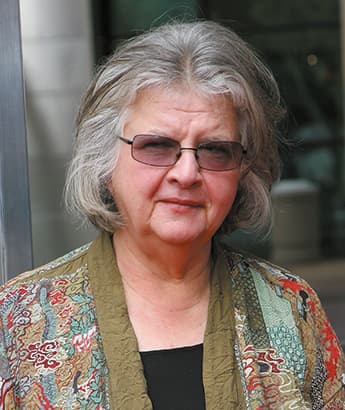
Name: Dr. Biruté Mary Galdikas
Born: 10 May 1946
Died: 24 March 2026
From: Canada, North America
Lived: Borneo, Indonesia, Southeast Asia
Studied: Psychology, zoology, anthropology
Famous for: Conducting the world’s longest continuous study of wild orangutans and discovering many important facts about their lives.
What did Dr. Biruté Galdikas discover?
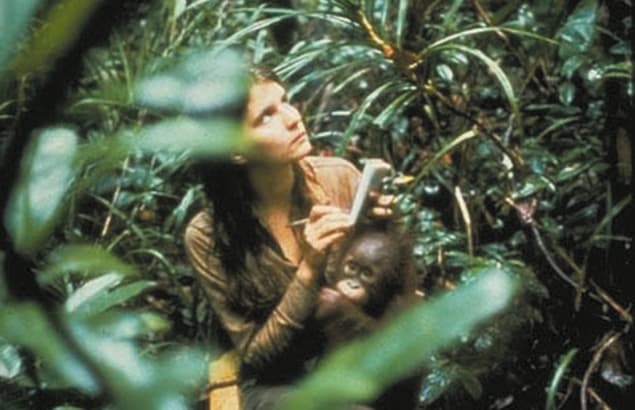
Most of what we know about orangutans is thanks to Dr. Galdikas’ immersive research. Here are some of the things she’s observed:
- – Orangutans eat over 400 types of food!
- – Baby orangutans stay with their mothers for 7.7 years – the longest ‘birth interval’ of any mammals
- – Rehabilitated ex-captive orangutans can use various types of tools and imitate behaviours
- – Orangutans lead semi-solitary lives and rarely mate
- – Females stay in one place whereas males tend to leave
Biruté Galdikas interview
NGK: Hi, Dr. Galdikas! Can you remember when you first became drawn to orangutans?
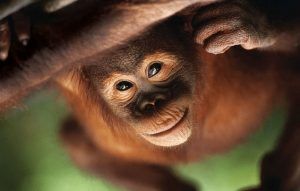
Biruté: When I was an adolescent I saw a very distinctive photograph of a sub-adult male orangutan in a Time Life book. If you looked at him from his lower lip up, he could have been human. The eyes, his expression. When I saw that photograph, I felt a connection that has always stayed with me.
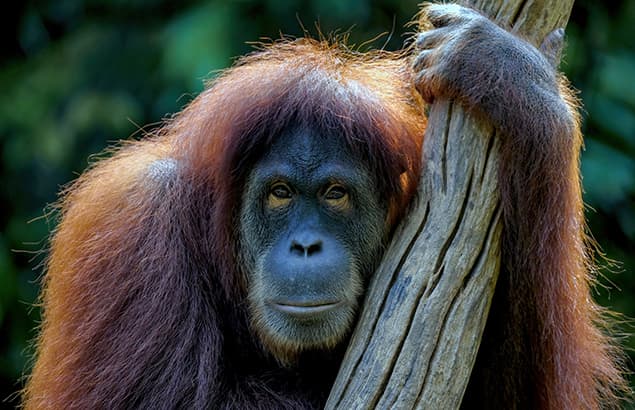
After 50 years studying them, how would you best describe orangutans?
In many ways they’re like animals created by Walt Disney! They’re gentle, and have a sense of humour and distinct personalities. You can usually read what their emotions are. Their expressions are very accessible.
Did you know? In the Malaysian language, orangutan means ‘person of the forest’.
After university, you were determined to study orangutans in the wild. How did this come about?
At 19, I already knew about Jane Goodall – my professor had mentioned a young English woman who was living with chimpanzees in Africa. (Click here to learn about Jane Goodall). I knew Jane had been encouraged and supported by a scientist called Louis Leakey, so I went to see him give a lecture.
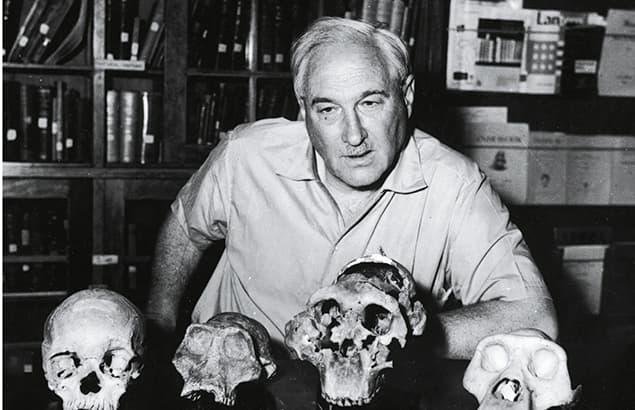
At this talk I learned that he also supported Diane Fossey and her work with gorillas. He was a great showman and at one point he hammered his shirt pocket and said he had JUST received a telegram from Diane Fossey about a wild gorilla untying her shoelaces!
That’s when I knew this was the man who was going to unlock the universe for me. And that’s why I went up to him after the lecture and asked him to support me in my wish to study orangutans in the wild.
How did he respond?
He had been looking for somebody to study orangutans. And I walked into his life and said, “Will you help me study orangutans?” So that was that. He said, “You are my person. I’m going to help you.”
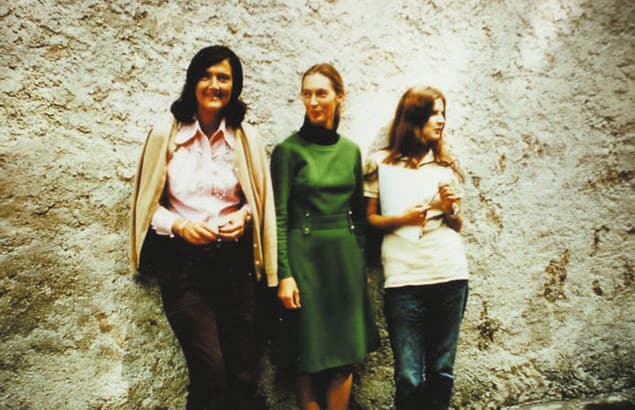
In 1971, you travelled to Borneo in Southeast Asia to set up Camp Leakey, a research centre in Tanjung Puting National Park. What was it like?
It was almost like a dream. It was so surreal that I was actually there in Indonesia and yet I had this feeling, like I was coming home.
What was a typical day like?
The approach was similar to Jane Goodall‘s. I followed the orangutans when I found them until they made a nest for the night. And then I would return in the morning before dawn to watch them leave the nest. I would follow them day in, day out. There was a female we followed for 30 days and one male that we followed for 60 days!
What were you trying to discover?
We were trying to gather all the details of an orangutan’s life. We wanted to understand their ecology, what they ate, and their social behaviour.
Was it hard to follow them?
They don’t move that fast. Studies show the amount of energy orangutans use when they move through the canopy is about the same as we humans use sitting on our couches watching TV!
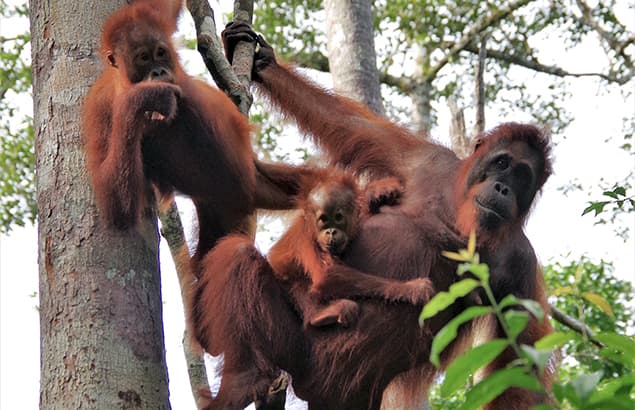
So are they up in the trees the whole time?
Orangutans spend 95% of their time up in the canopy. They’re the largest arboreal creatures on the planet. An orangutan might stay in one tree for up to eight hours, where you can barely see them, so following an orangutan isn’t necessarily the most exciting thing in the world.
I have to admit that sometimes I would read murder mysteries while waiting for them to leave their nests!
Haha! Were there any interactions between you and them?
Initially yes. They would ‘kiss squeak‘ [a threat sound], they would throw branches, they would defecate. I never got hit but my former husband who was with me in the beginning once got hit in the eye!
Oops, oh dear!
They could be hostile. They would throw dead tree branches and push over dead trees, which could be dangerous. Sometimes they would stare and stare. But different orangutans would react differently and had different ‘rules‘.
So they had distinct personalities?
Absolutely. But because they didn’t really interact with each other that much, you couldn’t easily get a sense of their social behaviours. They are mostly solitary animals.
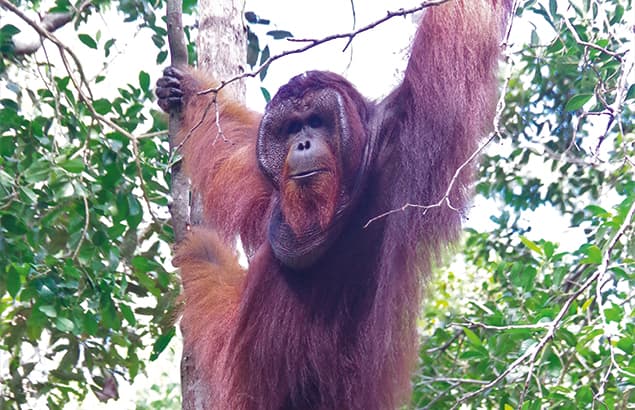
How long did it take for the wild orangutans to get used to you?
Well, I remember one old female whose name was Priscilla. It took her about 15 years!
Wow, that’s a long time!
The males usually take less time. It depends on the individual.
Does orangutans’ solitary nature make them difficult to study?
Yes – in fact, Jane Goodall once said it took me a year to collect the kinds of social data that she could collect in a day with chimpanzees, who are much more gregarious and social. I remember I once had an Indonesian student who wanted to study mating behaviour. He was there for six months and he only saw one incidence of mating!
Is that because they don’t have babies very often?
That’s right. Orangutans have the longest birth interval of any mammal that has been studied. In my area they only have a baby on average once every eight years.
Are the mothers and babies very close?
A baby stays with its mother for the first 7-8 years of life, until she gives birth to the next infant. Sometimes the baby will suckle until the age of seven, but while it’s with her it learns what foods to eat.
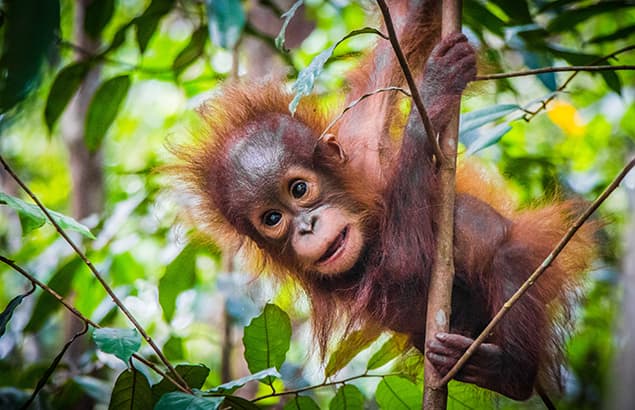
Do they then move away?
Females usually live in their mother’s range for their entire lives, but they won’t stay with her. One of the things I noticed is that all females look very much alike. And we did a genetics study recently which seems to suggest that females in this area were all on average as closely related as cousins.
What about the males?
When males reach puberty they start travelling and most of the time they leave. So males aren’t as closely related.
After you arrived, as well as studying wild orangutans, you began looking after rescued ex-captive orangutans. Were they being kept as pets?
You wouldn’t call them pets exactly – if you have a sub-adult male orangutan, he’s not going to be a pet! He would be in a cage. But some females, even adults, can be quite friendly.
I became very friendly with some of the females who were rehabilitated at Camp Leakey. Some even became my best friends. They’d go away into the forest for days, but they would still come back and sit on my porch with me.
Wild-born ex-captive orangutans have been seen using paintbrushes, pushing themselves along in canoes, trying to make fires and using ladders!
Wow! Did you look after orphans, too?
Yes. Sadly, as the rainforests are ravaged, people kill the mothers and take the infants for the pet trade. These orphans come to us after they are confiscated from private owners by government officials.
Local people may also bring their captive orangutans to us after realising that it’s illegal to keep them, or because they’re too much trouble to look after.
And so you became their adoptive mother?
That’s right. I have always tried to replicate the experiences that orangutan infants and youngsters have in the wild. When I first started, 5-6 infants stayed in the hut at Camp Leakey with me and they would just follow me around the forests in the day and then come back with me at night. Some of the orphans would sleep on the same mattress as me! But by 1998 there were so many orphans that we opened a specialised orangutan care centre.
More than 800 orphaned and ex-captive orangutans have been rescued and rehabilitated by Dr. Galdikas.
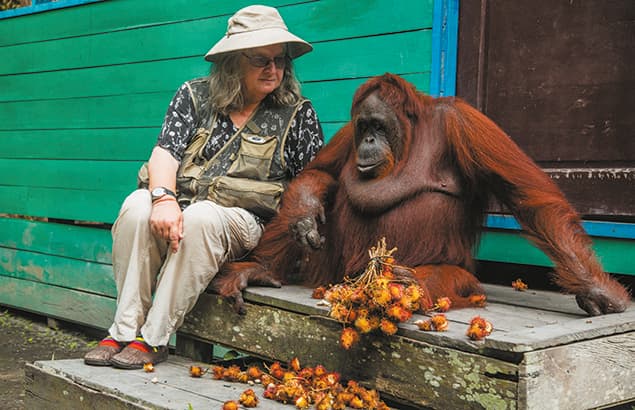
You must have formed some strong connections. Can you share stories about any memorable orangutans?
Well, the first female who came to Camp Leakey as a wild-born ex-captive was named Akmad. She was so gentle. Other orangutans would come into my hut and trash it, but once she came in and carefully picked up a bag of peanuts before walking out again.
I hadn’t seen her for many years and then one day she came by Camp Leakey, briefly walked around and left. i think she had come to say goodbye – I never saw her again.
That’s so sad.
Yes. But it’s also so joyful when you release them back into the wild.
How does that process happen?
The infants are first quarantined for 30 days, and we have four Indonesian vets who monitor their health. We have sleeping cages for them and over 100 hectares (250 acres) of forest for them to play in during the day. Local caregivers become their surrogate mothers.
Typically, healthy infants stay until they’re at least eight – the age they leave their mothers in the wild. Then, when they’re ready, we try to release them.
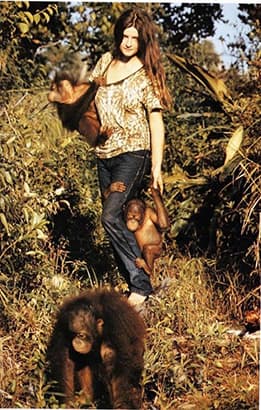
Is it difficult to find places to release them because of deforestation?
Yes, that’s the problem. You can travel for hours and hours and not see forests any more – only palm oil plantations. (Click here to learn more about palm oil.)
Do you feel hopeful about the future?
I am hopeful – because that’s the human way. But you can have all the hope in the world and if there’s no action it isn’t going to get you anywhere. So some things you can do are avoid palm oil, avoid meat, stay aware of what’s happening and write letters to politicians.
Great tips. Thank you for speaking with us Dr. Galdikas!
How to help orangutans
The problem with palm oil
Palm oil is the world’s most widely produced vegetable oil. The fruit of the West African palm, it’s originally from West Africa and only grows in tropical rainforest climates. But now about 85% of palm oil comes from Indonesia and Malaysia, where orangutans live in the wild.
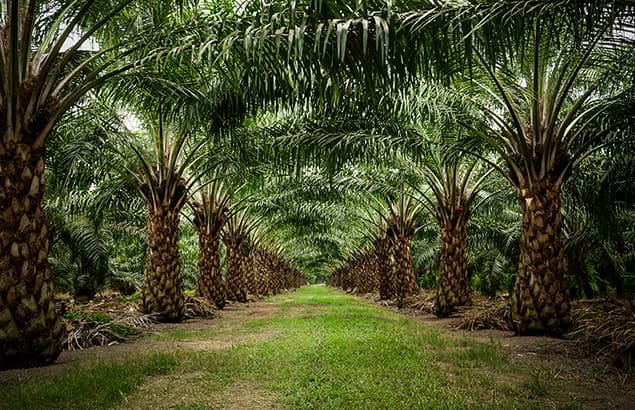
Rainforests are destroyed to make way for vast oil palm plantations in a process called deforestation, leaving many creatures without a home. These plantations are responsible for the deaths of up to 5,000 wild orangutans every year.
This aggressive agriculture isn’t just bad news for orangutans – it sucks for the entire planet. That’s because when we convert rainforest to farmland, the process releases carbon dioxide, causing climate change. And pesticides and fertilisers used to grow palms kill native plants and pollute water sources for local people and wildlife.
Top tips to avoid palm oil

A whopping 50% of all processed food and household products in the West contain palm oil, from biscuits and ice cream to shampoo, toothpaste, animal food, bath and beauty stuff and washing-up liquid. So how can you steer clear?
- – Non-processed foods don’t tend to contain palm oil – so eat freshly-cooked meals when you can.
- – Ask your parents to buy from companies known to avoid palm oil, such as Suma and Planet Organic.
- – Make your own products so you know what’s in them! Detergent, shampoo and cleaning products can all be created at home. Head to orangutan.org and download the palm oil awareness guide for instructions.
- – Look out for NO PALM OIL labels on food and products.
Found out that one of your favourite products contains palm oil? Write to or email the company with your concerns!
You can also help by raising money and donating it to an orangutan charity such as Orangutan Foundation International. Find out more at orangutan.org
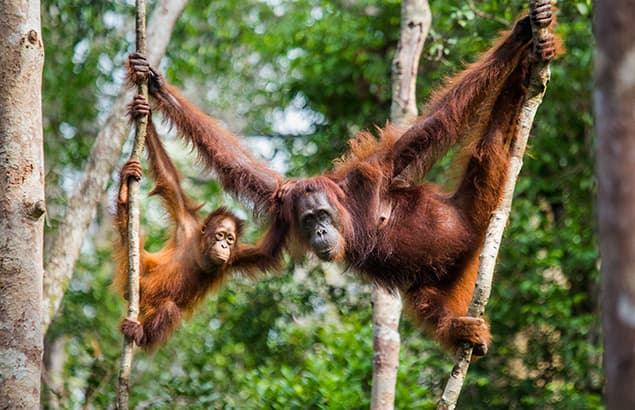
Find out more about Dr. Biruté Galdikas…
Read: Undaunted, a National Geographic Kids book about her life.
Watch: Born to be Wild and The Last Trimate – both films about Biruté’s work – and the National Geographic short film A Rare Look at the Secret Life of Orangutans.
Online: Check out loads of amazing orangutan info at orangutan.org
What do you think of Biruté Galdikas’ extraordinary life? Tell us in the comments below!
Image credits: Biruté headshot and Louis Leakey © Getty Images UK; Orangutan portrait, orangutan baby, oil palm plantation, ‘Palm Oil Free’ logo and final orangutan mum and baby © Adobe Stock. All others © Orangutan Foundation International.
 Likes
Likes






LEAVE A COMMENT
THANK YOU
Your comment will be checked and approved shortly.
WELL DONE,
YOUR COMMENT
HAS BEEN ADDED!
COMMENTS
mehli
i dont like monkeys.
Tim
So cute
Rowboaty
So gentle and friendly !
baby orangutans are so cute!
balls
animals are cute
Gaby
my friend called Ella loves these animal they are so cute !!!!!!!!
mia
this is nice
Emily
this is nice
i love it!!!!!!!!!!!!!!!!!!!!!!!!!!!!!!!!!!!!!!!!!!!!!!!!!
Jessica
What a beautiful life
Wow !!!!!!!!!!!!!!!!!!!!!!!!!!!!
harris
big monkey
Josie
Shark girl I agree with you she does look like Jane Goodall. I love Dr. Biruté Mary Galdikas she is amazing!
Flo
she is a person to admire
h
so cool
Mete
What an amazing person. I admire what she did !
King kobra
Love what you’re done ing for those amazing animals
Hannah
That was so long!
Me
Amazing and super helpful
Mabel
I LIKE THE PICS!
Bobbie
Good Article. V long
Manon ❤
Intresting
Shark girl
She reminds me of Jane Goodall
Jo peterson
I like your article
CUSTOMIZE YOUR AVATAR