






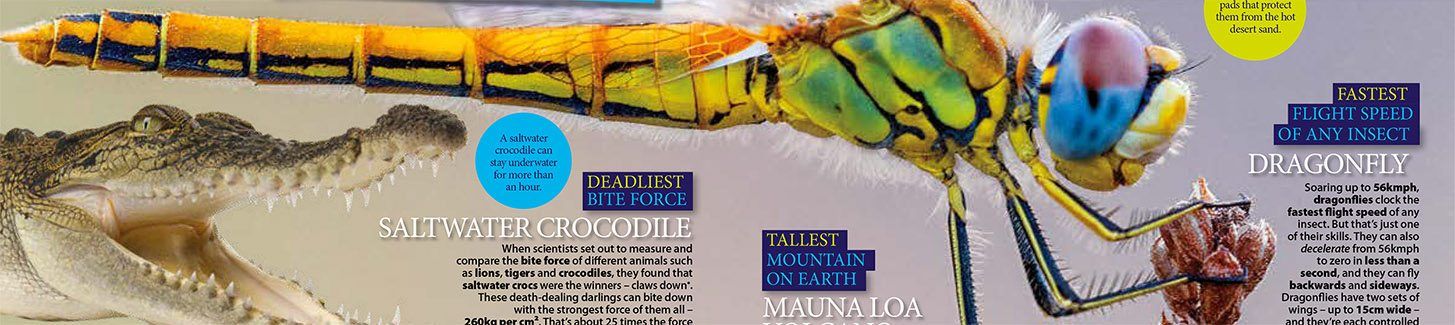
Extreme records: Maths primary resource
Practise using units of measure and comparing values in a real-world context
This Maths primary resource helps with the teaching and learning of speed, time, force, temperature and height values by examining world records in the animal kingdom. Use these fun, real life example to open opportunity for discussion about values and units of measure.
Pupils will have the opportunity to discuss and compare units for measuring using our National Geographic Kids’ Measures primary resource sheet.
The teaching resource can be used in study group tasks, as a printed handout for each pupil, or for display on the interactive whiteboard.
Activity: Ask children to create a table consisting of three columns, listing each of the animals and places mentioned in the resource as the rows in that table. Label the three columns: ‘Value’, ‘Unit of measure’, ‘Type of measurement’. Under each of these headings write out all of the numbers included in the resource and their units of measure (i.e. the Lut Desert row would say: Value = 70.7; Unit of measure = degrees Celsius; Type of measurement = heat/temperature and Value = 475; Unit of measure = metres; Type of measurement = height). How many differ types of measurement are included in the resource? Children could compare and contrast the values from the resource with some of their own collected examples of measurement, such as the fastest flying animal, the heaviest animal, etc.
N.B. The following information for mapping the resource documents to the school curriculum is specifically tailored to the English National Curriculum and Scottish Curriculum for Excellence. We are currently working to bring specifically tailored curriculum resource links for our other territories; including South Africa, Australia and New Zealand. If you have any queries about our upcoming curriculum resource links, please email: schools@ngkids.co.uk
This Maths primary resource assists with teaching the following Key Stage 1 Maths objectives from the National Curriculum:
Pupils should be taught to:
- compare, describe and solve practical problems for: time [for example, quicker, slower, earlier, later]
Pupils should be taught to: measure and begin to record the following:
- lengths and heights
- mass/weight
- time (hours, minutes, seconds)
National Curriculum Lower Key Stage 2 Maths (Year 3) objectives:
Pupils should be taught to:
- estimate and read time with increasing accuracy to the nearest minute; record and compare time in terms of seconds, minutes and hours
- Compare durations of events (for example to calculate the time taken by particular events or tasks)
National Curriculum Lower Key Stage 2 Maths (Year 4) objectives:
Pupils should be taught to:
- convert between different units of measure (for example, kilometre to metre; hour to minute)
This Maths primary resource assists with teaching the following Numeracy and mathematics First level objectives from the Scottish Curriculum for Excellence:
- I have begun to develop a sense of how long tasks take by measuring the time taken to complete a range of activities using a variety of timers
Scottish Curriculum for Excellence Second level Numeracy and mathematics objectives:
- Using simple time periods, I can give a good estimate of how long a journey should take, based on my knowledge of the link between time, speed and distance
Scottish Curriculum for Excellence Third level Numeracy and mathematics objectives:
- Using simple time periods, I can work out how long a journey will take, the speed travelled at or distance covered, using my knowledge of the link between time, speed and distance
Scottish Curriculum for Excellence Fourth level Numeracy and mathematics objectives:
- I can use the link between time, speed and distance to carry out related calculations
Download primary resource
Note: This is a subscriber-only benefit. If you have an active subscription, please log into your online account to download the files.

More Like



Wundersmith: The Calling of Morrigan Crow






LEAVE A COMMENT
THANK YOU
Your comment will be checked and approved shortly.
WELL DONE,
YOUR COMMENT
HAS BEEN ADDED!
COMMENTS
Marie
nice
CUSTOMIZE YOUR AVATAR